
Gas and electric systems differ in more than fuel price: electrical capacity, burner recovery, exhaust design, permits, noise and daily workload can change the better choice. By comparing those factors with your animal sizes, batch volume and site limits, you can specify the right system and reject equipment that only looks efficient on a brochure.
Key takeaways
- Match energy choice to batch mass, daily volume and recovery time.
- Ask suppliers for chamber dimensions, batch mass and cycle-time figures.
- Check secondary-chamber performance and emissions-control requirements before buying.
- Compare gas infrastructure, electrical load, labour and maintenance obligations.
Choose gas or electric from workload, not chamber temperature
Choose the energy source that matches batch mass, daily volume and recovery time—not the highest chamber-temperature figure. A low-volume clinic processing small animals for one or two cycles daily may favour electric heating, especially where gas is unavailable or stack restrictions are tight.
A high-throughput facility handling large animals needs the faster recovery and sustained heat input that a gas system can provide.
| Option | Best workload fit | Utility and operating consequence |
|---|---|---|
| Gas | Large animals, repeated batches, long operating hours | Needs dependable gas supply, burner ventilation and fuel storage or piping; usually suits higher throughput |
| Electric | Small-to-medium animals, fewer daily cycles, restricted sites | Needs adequate three-phase electrical capacity; quieter operation and no on-site burner emissions, but recovery can be slower at high loads |
| Hybrid | Variable volume or sites needing backup | Combines gas burners and electric elements; confirm whether operators can switch sources between cycles or run both during one cycle |
Use the pet animal incinerator comparison on actual workload: maximum animal weight, batch capacity, cycle time, cooldown or recovery time, monthly cycles and available electrical load. A large chamber does not guarantee capacity if the secondary oxidation zone, fan or chimney is undersized.
The pet animal incinerator gas or electric choice also depends on permits and utilities. Gas creates direct stack emissions from the burner and remains, while electric removes burner emissions but still needs airflow, secondary oxidation and exhaust control for smoke and pyrolysis gases. Compare fuel and electricity cost per completed cycle, not per hour.
Specify the numbers that reveal real capacity
Reject any quotation that gives only chamber volume or peak temperature. Compare the heat input, stated batch mass, cycle time and recovery time for the same animal load. A gas pet animal incinerator and an electric pet animal incinerator can share a chamber size yet deliver very different daily throughput.
| Specification | Gas pet animal incinerator | Electric pet animal incinerator | Hybrid quotation |
|---|---|---|---|
| Maximum batch | Animal weight in kg, loading dimensions and ash capacity | Animal weight in kg, loading dimensions and ash capacity | Capacity with gas, electric, or both operating |
| Heat input | Burner rating in kW, fuel type and consumption per cycle | Installed heater kW and element arrangement | Separate gas and electric ratings, plus combined rating |
| Electrical service | Connected load, phase, voltage and protective-device rating | Connected load, phase, voltage and protective-device rating | Service required with both systems enabled |
| Recovery | Heat-up time and return-to-temperature time after a stated load | The same two times; low kW can reduce throughput | Times for each mode and for changeover |
| Combustion | Secondary-zone temperature, residence time, airflow and thermocouple location | The same values; electric heating does not remove pyrolysis gases | Controls and limits for each heat source |
| Exhaust | Chimney draft, fan capacity and makeup-air requirement | Exhaust capacity, negative pressure and corrosion protection | Exhaust design at maximum combined load |
Request a heat-balance sheet, cycle record for a specified batch mass, and the maximum operating load. For electric pet cremation equipment, check that a 30 kW, 240 V single-phase heater would draw about 125 A before auxiliaries; larger units can require three-phase service.
Confirm whether the quoted 850 °C secondary-gas condition is a permit requirement at your site, not merely a display setting.
Understand the cycle, secondary chamber and emissions controls
Smoke and odour are controlled in the secondary chamber, not by the energy source alone. The primary chamber dries and burns the remains; the secondary zone then oxidises smoke and pyrolysis gases before the induced-draft fan carries exhaust through the duct and chimney.
| Option | Emissions behaviour during the cycle | Main control point |
|---|---|---|
| Gas | Adds burner combustion gases to emissions from the remains. | Maintain secondary-zone temperature, residence time, turbulence and oxygen; tune the burner and fan together. |
| Electric | Removes on-site burner emissions but still produces smoke, carbon monoxide and odour from the remains. | Size the secondary chamber, airflow path and exhaust for the gas volume, then hold stable oxidation conditions. |
An afterburner works only when it has sufficient temperature, residence time, mixing and oxygen. Raising burner output alone can increase fuel use and stack temperature while carbon monoxide or a visible plume remains. Electric elements can maintain an even setpoint and still fail if airflow or the oxidation zone is undersized.
During commissioning, request recorded secondary-chamber temperature, oxygen, carbon monoxide, cycle time and the temperature-sensor location. A published chamber setpoint proves little; EU animal-by-product rules specify 850 °C treatment of combustion gases for prescribed installations, while local permits can add conditions. Excess loading, wet remains or cold refractory can defeat either system.
Use this test in a pet animal incinerator comparison:
- Confirm the secondary zone reaches its required condition before loading.
- Check carbon monoxide and visible emissions through the full burn and cool-down.
- Match the fan, duct and chimney to peak gas volume, not chamber size alone.
- Treat pet cremation equipment as compliant only after site commissioning evidence.
Compare installation, labour, maintenance and site obligations
A gas pet animal incinerator usually demands more site infrastructure; an electric pet animal incinerator demands more electrical capacity. Both need a level, load-rated foundation, clearance from combustibles, an engineered exhaust route and access for refractory repairs. A slab that cannot carry the furnace and charging load will crack, distort doors and misalign the flue.
| Option | Foundations and utilities | Exhaust and safety | Servicing and daily operation |
|---|---|---|---|
| Gas | Reinforced slab, gas connection, pressure regulator, fuel train, combustion air and electrical controls | Insulated flue, secondary oxidation zone, carbon-monoxide protection, flame supervision and automatic gas shutoff | Burner tuning, leak checks and nozzle cleaning; an operator manages loading, ash removal and fuel-related alarms |
| Electric | Reinforced slab plus cable route, isolator, high-current supply, contactors or solid-state controllers and possible transformer upgrade | Insulated flue and controlled airflow remain necessary; over-temperature and airflow interlocks protect elements and operators | Inspect elements, terminals, sensors and controllers; the operator still loads, removes ash and waits for recovery after a heavy batch |
Gas installation creates fuel-permit and ventilation obligations. Electric installation avoids burner servicing and on-site fuel storage, but an undersized supply causes slow heat-up, nuisance trips and lost cycles.
Before accepting a quotation, require confirmation of:
- foundation load and anchor details
- flue diameter, height, termination and cleaning access
- electrical load in kilowatts or gas pressure and consumption
- fire protection, emergency isolation and operator training
- service intervals, spare parts and response arrangements
Use commissioning evidence to make the final choice
Do not choose a pet animal incinerator gas or electric from its brochure setpoint. Require a witnessed site trial using the heaviest and most difficult animal load you expect, then make payment conditional on recorded cycle results, ash inspection and emissions testing.
- Cycle performance: record primary and secondary-zone temperatures, temperature-probe locations, oxygen, cycle duration, recovery time and electrical or fuel consumption. Confirm stable secondary combustion; 850 °C combustion-gas treatment applies to prescribed installations under EU animal-by-product rules, while your permit may set a different requirement.
- Ash quality: inspect the cooled ash for unburned tissue, char, excessive clinker and metal residue. Weigh the input and recovered ash, photograph the result and repeat the test with a normal batch.
- Emissions: use the method named in your permit or approval to measure carbon monoxide, nitrogen oxides, particulate matter, oxygen and visible emissions at the stack. Compare gas and electric results on the same batch mass, not per cycle.
- Controls: test flame failure and automatic gas shutoff on gas units; test over-temperature protection, airflow and exhaust interlocks on electric units. Record alarms, shutdowns and restart behaviour.
- Documentation: obtain as-built drawings, calibration certificates, operating instructions, maintenance intervals and the signed commissioning report.
Ask KALYANI FURNACES INDIA PVT LTD to include these acceptance tests and permit-support documents in the quotation for its pet cremation equipment. A unit that passes temperature checks but leaves poor ash or fails the permitted stack test is not acceptable.
Related product
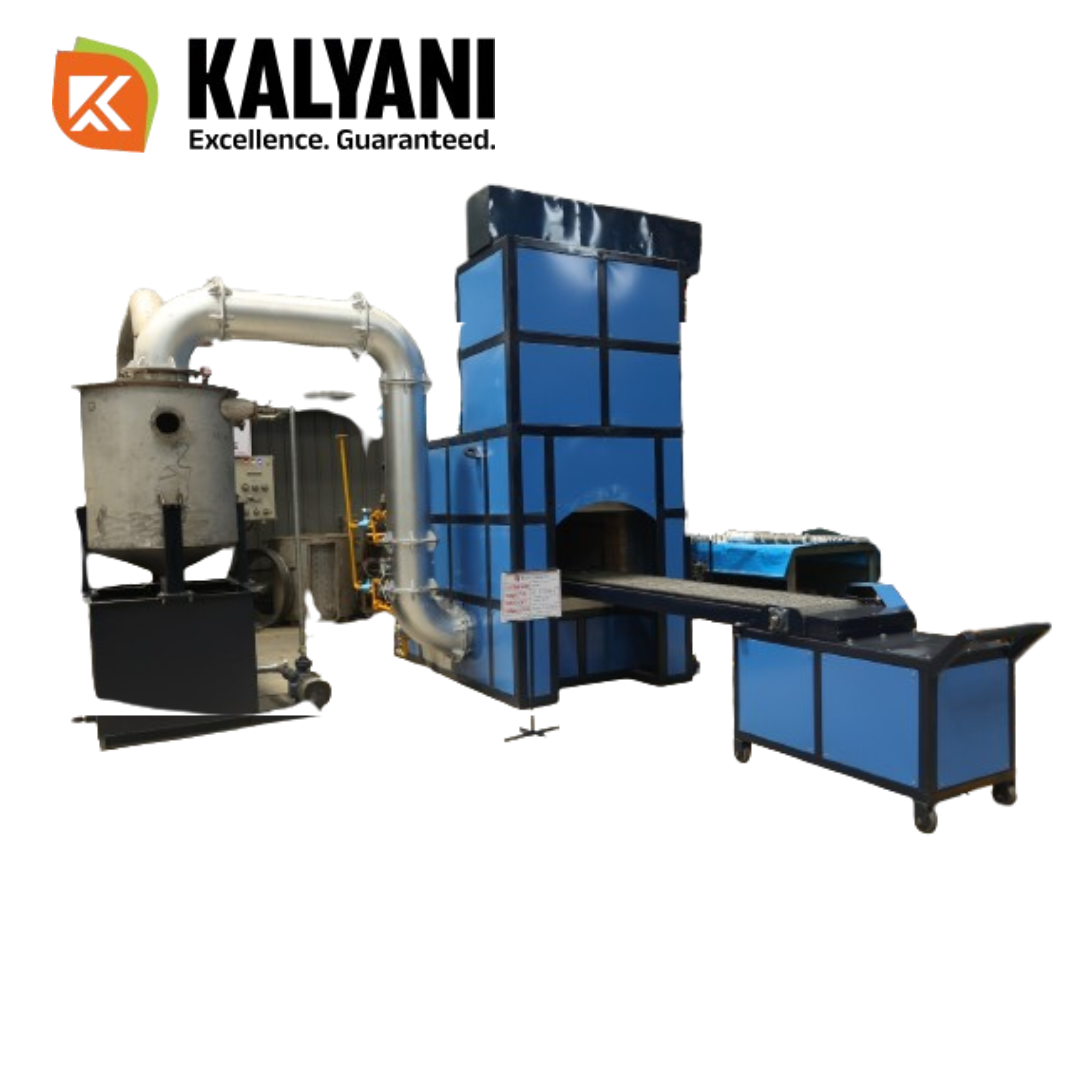 | CREMATORIUM & INCINERATORS Pet Animal Incinerator (Gas / Electric / Hybrid) Product Overview The Pet Animal Incinerator (Gas / Electric / Hybrid) by Kalyani Furnaces India Pvt. Ltd. |
Frequently asked questions
Is gas or electric better for a pet animal incinerator?
Choose from batch mass, daily volume and recovery time. Electric equipment suits low-volume sites with limited gas access, while gas can suit heavier or more frequent workloads when fuel infrastructure is available.
Which capacity figures should you request from a supplier?
Request usable chamber dimensions, maximum batch mass, recommended batch mass, cycle time, cooldown time and the number of cycles per day. Chamber temperature alone does not reveal processing capacity.
Why does a pet incinerator need a secondary chamber?
The secondary chamber provides additional combustion time for gases released from the primary chamber. Compare its temperature, residence-time specification, burner control and emissions-monitoring provisions.
What installation obligations differ between gas and electric equipment?
Gas systems require fuel storage or a supply connection, regulators, pipework and combustion ventilation. Electric systems require a suitable electrical supply, protection devices, cable capacity and site approval for their connected load.